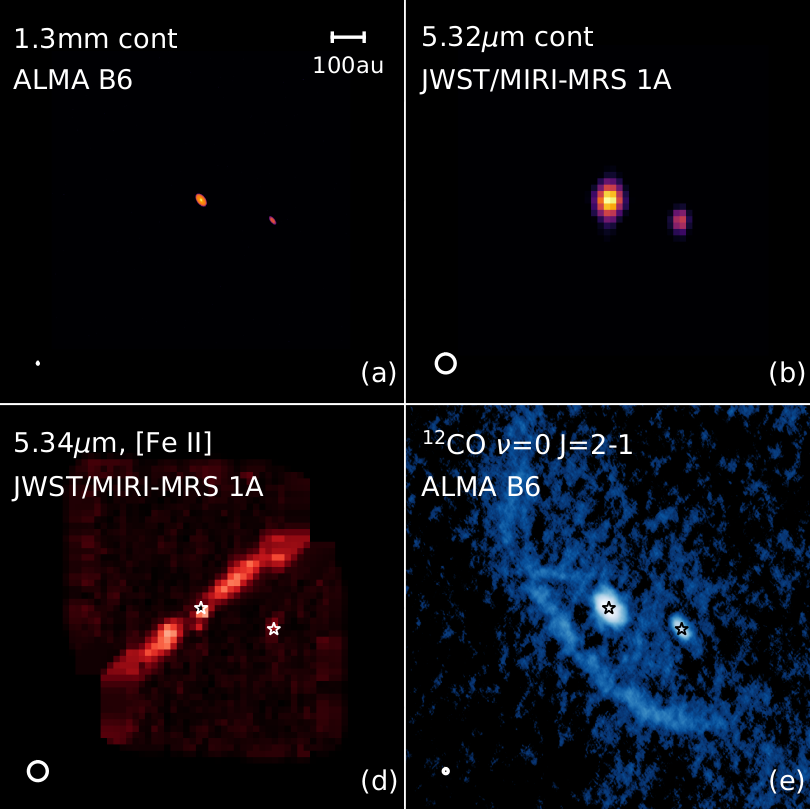
The impact of external companions in the inner disk composition.
Observations from the MINDS collaboration, with the JWST/MIRI-MRS instrument, allowed us to explore how the dynamical interactions could influence the inner disk composition. We found evidence of bright jets, variable water emission, among some other interesting results. .
Publication: ADS
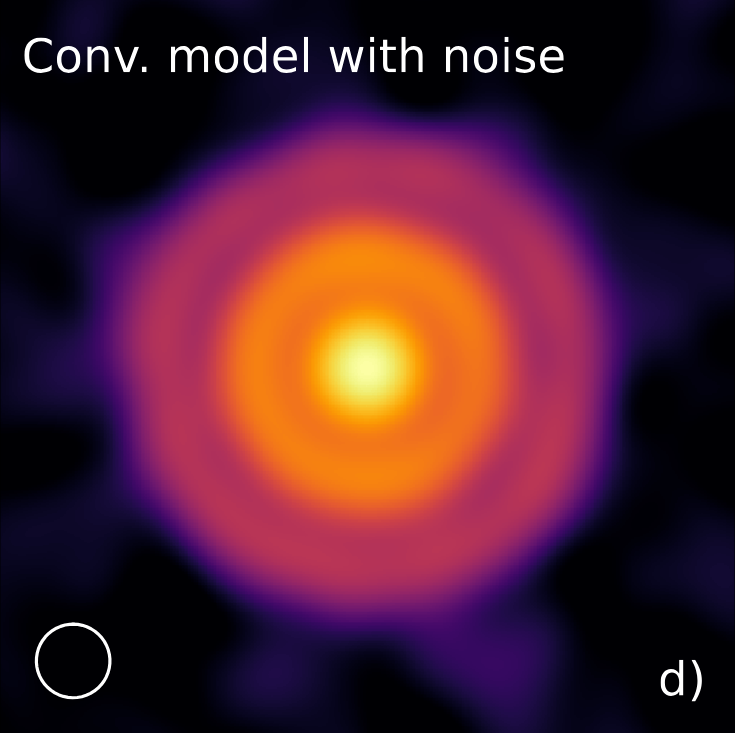
The evolution of dust emission is consistent with the presence of dust traps.
As part of the ALMA Large Program AGE-PRO, I explored which properties of the AGE-PRO sample could be explained purely with viscous evolution. The dust evolution across different star-forming regions is consistent with a population of disks with at least weak dust traps.
Publication: ADS
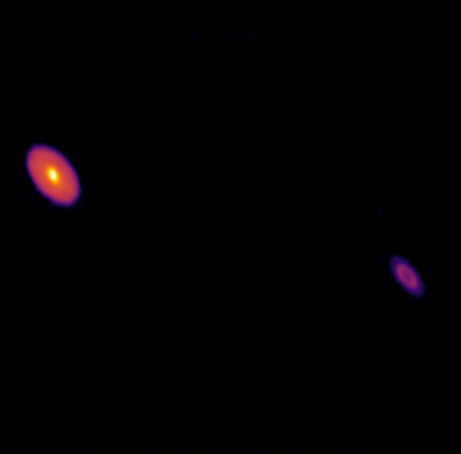
The RW Aur binaries interacted a few hundred years ago
Extremely precise astrometry measurements made with ALMA observations, and historical multiwavelength observations, have allowed the determination of RWAur B orbit around A. The periastron of the orbit is comparable to the extension of their gas disks, which indicates the systems collided a few hundred years ago.
Publication: ADS
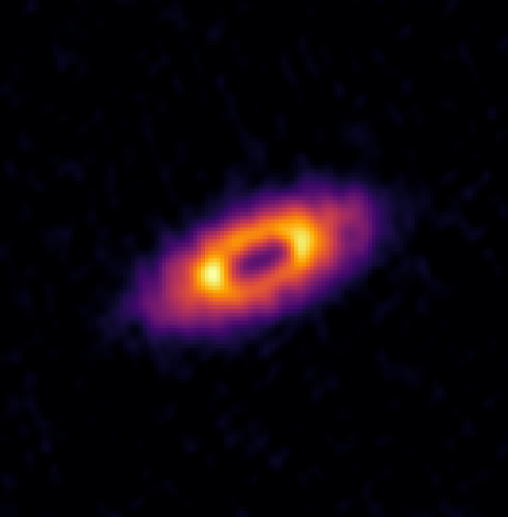
The temperature structure of a VLMS disk
VLMS disks are cold and compact, challenging standard analysis tools. By analyzing the gas emission directly in the visibility plane, we got robust constraints on the disk height and temperature structure.
Publication: ADS

Connecting simulations to observations
Generating synthetic observations has never been easier. The SIMIO package is an extension for the CASA software, wrapping multiple functions to help with the comparison of simulations with real observations. This package works as a complement to the capabilities of simobserve.
Publication: ADS
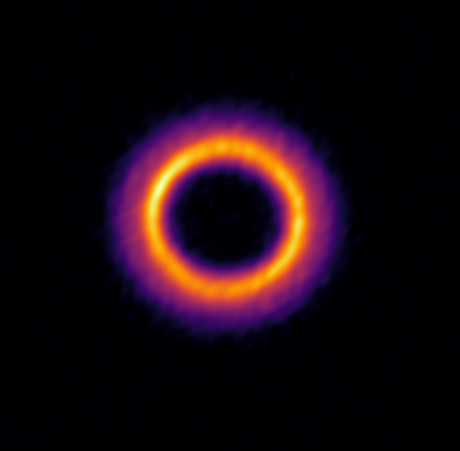
Planet formation in a circumbinary system
The disk around the binary CS Cha shows a very small eccentricity, which we measured by modeling the interferometric visibilities. Through hydro simulations, I demonstrate that the binaries cannot explain the disk morphology, and a Saturn-like planet orbiting at the edge of the cavity is more consistent with the observations.
Publication: ADS
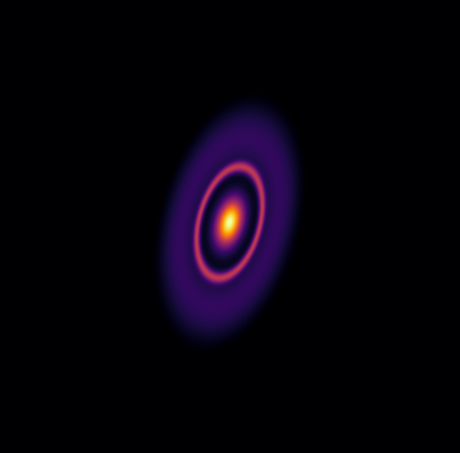
Very Low Mass Stars show evidence of planet formation
I studied six disks around Very Low Mass Stars in Taurus. The sample shows evidence of strong dust radial drift, as high ratios between the gas and dust extent are detected. I also found dust substructures in all the disks that are well resolved by our resolution of 0.1''. The results suggest that substructure detection is limited by resolution and sensitivity, even in VLMS.
Publication: ADS
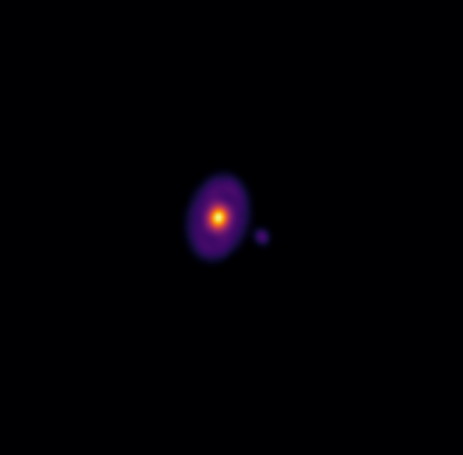
Dust substructures in Multiple Disk Systems (DSHARP IV)
Tidal interactions between stars-disks in multiple stellar systems can interfere with planet formation processes. I studied the dust substructures in the multiple stellar systems HT Lup and AS 205 and found: the first dust spirals in a binary system, truncated disks, fly-by interactions, and disk misalignments.
Publication: ADS